
Research 13.6.2019
Eva Hesse
Finding inspiration in the human body, the random occurrence, the process of improvisation, and the liberating qualities of nontraditional materials such as industrial felt, molten lead, wax, and rubber, these artists mined a new aesthetic sensibility variously known as Anti-Form, Post-Minimalism, or Process art.
During her brief career Hesse contributed to this radical undermining of artistic convention with her abstract yet sensual sculptural works. She rejected the standard attributes of monumental sculpture—volume, mass, and verticality—in favor of eccentric forms made from rope, latex, and cheesecloth, all of which decompose with time. Her goal, she explained, was to portray the essential absurdity of life. In formal terms, this theme was realized through a wedding of contradictions: “order versus chaos, stringy versus mass, huge versus small,” in the artist’s words. Acutely aware of the challenges faced by a female artist in a predominantly male environment, Hesse may have utilized such formal opposites as a metaphor for her own position in the art world and to emphasize the inherent strength of flexibility and vulnerability.

Expanded Expansion is a sculptural embodiment of opposites united. Both permanence and deterioration operate in the piece: fiberglass poles—rigid, durable entities—are juxtaposed with fragile, rubber-covered cheesecloth. While its height is determined by the poles, the width of the piece varies with each installation; like an accordion or curtain, it can be compressed or extended. Its repetitive units echo the programmatic seriality of Minimalism, but here they accentuate Hesse’s desire to illuminate her view that “if something is absurd, it’s much more exaggerated, more absurd if it’s repeated.” The very redundancy of the title reinforces this idea.
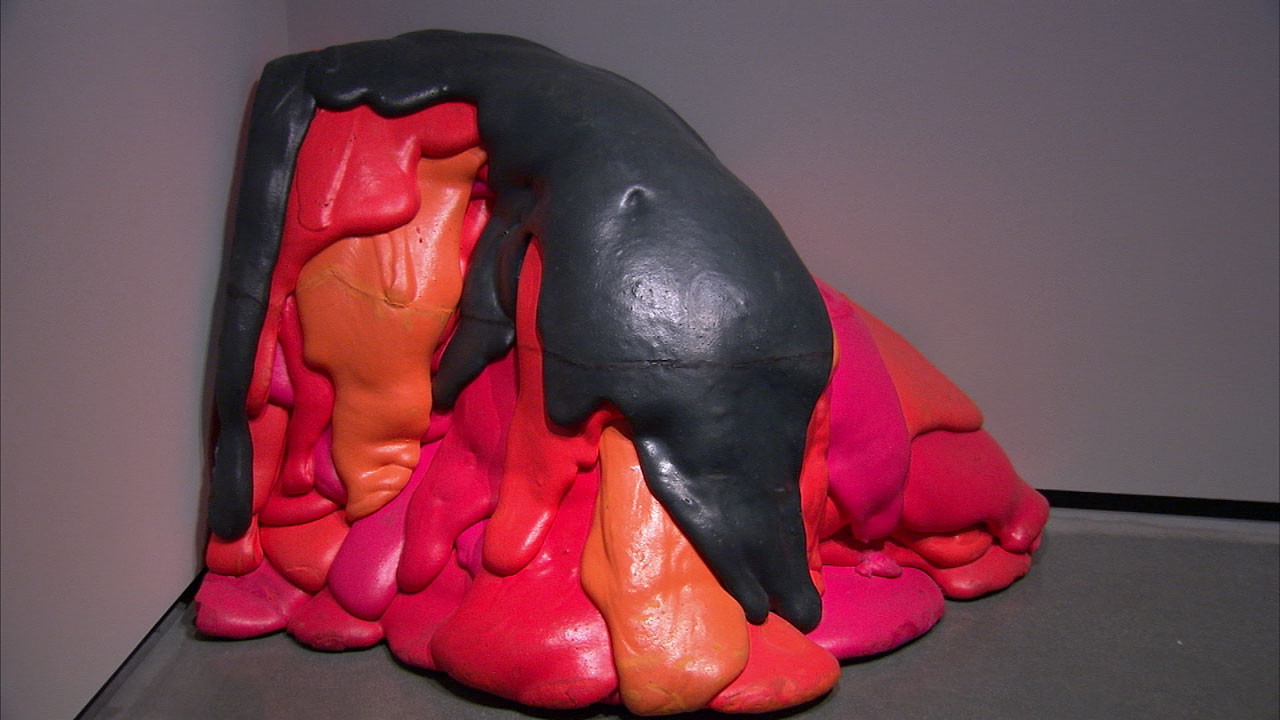
Lynda Benglis
A pioneer of a form of abstraction in which each work is the result of materials in action—poured latex and foam, cinched metal, dripped wax—Lynda Benglis has created sculptures that eschew minimalist reserve in favor of bold colors, sensual lines, and lyrical references to the human body. But her invention of new forms with unorthodox techniques also displays a reverence for cultural references that trace back to antiquity. Often working in series of knots, fans, lumps, and fountains, Benglis chooses unexpected materials, such as glitter, gold leaf, lead, and polyurethane. In more recent works, she explores diverse cultural heritages (Indian architecture, Greek statuary, Chinese ceramics), translating ancient techniques and symbols for use in contemporary contexts. In her early adoption of video, Benglis introduced feminist, biographical, and burlesque content to structuralist narratives.
Lisa Firer: "Going to Pieces without Falling Apart"
(with thanks to Mark Epstein

In this series of vessels, I explore what it means to feel a sense of cohesion, the sense that we are held together by the force of life in a quite miraculous way: body, mind and spirit. Some are created using separate pieces of clay that come together to form a vessel. In much the same way, we as beings, are a combination of many fragments that cohere to form vessels capable of holding such depth, creativity and beauty. We are layered, we are patterned, we are complex , we are beautiful. Other vessels are very loosely formed, with a softness that seems like it could collapse but is in fact in it’s fired state, contained and strong. We are wobbly, we are imperfect, we are unique, we are soft, we are strong.
This work is informed by my meditation practice and a direct exploration of what holds us together. I am finding that the only continuity that feels true is an open, spacious, loving connection, as best as possible, moment to moment, and breath by breath, to myself, to others and to the world. When so much threatens to pull us apart, these vessels remind me of our inherent wholeness.
I started working in porcelain in 2000 at the DK-SA artist-in-residency programme at the International Centre for ceramics, Skaelskor, Denmark. I have continued to work predominantly in this medium for the past 10 years. I work conceptually with the process of enlightenment and use the light transferring qualities of porcelain to explore this. The juxtaposition of the strength of this high fired clay and the delicacy of it when rolled very thin are also symbolic for me of the human condition, states of great strength and states of fragile vulnerability.
Karen LaMonte

The contours of valleys and peaks.


The attention to detail is amazing!
Karen LaMonte is an American artist known for her life-size sculptures in ceramic, bronze and cast glass as well as her large scale monotype prints. Her art deals largely with the central themes of beauty and loss, exploring the fragility of the human condition through a sartorial lens. LaMonte also began investigating the use of ceramic in her sculptures at the European Ceramic Work Centre and was the recipient of the Corning Museum of Glass/Kohler Arts Center Joint Residency for working with ceramic and glass.
Terminology
Semiotic: is the study of works of art signs and symbols, either individually or grouped in sign systems that can give us more insight from the work source and meaning. All painters work in a pictorial language by following a set of standards, basics and rules of picture-making.

I found this diagram to be very helpful in understanding the principles of semiotics.
Art Practice
Following on from the previous week's exploration of black/white tones.

I painted on half of the canvas white, masked it with tape and painted the other side black. One it was completely dry and using a piece of fraying cloth I repetitively "whipped" the canvas, first the black half and then the white. My hand and arm got covered in red paint too!

I continued to build up colour continuously striking the canvas (the white side) one hundred times. Once completely dry I carefully peeled off the masking tape to expose the unmarked white strip (line)
Masking tape resist/black paint

The first attempt of masking wasn't successful. I used way too much masking tape in multiple directions not thinking about the challenges in removing the tape!
Masking tape on canvas support/black paint

Here I have applied gesso and white paint to the canvas support. Once dry, I have masked the support with tape. A small blob of black paint dropped on the centre appears to "float" on the surface. After spreading the paint across the canvas and allowing it to dry I carefully peeled off the tape revealing the white paint.
Masking tape on canvas support/black and red paint

Sand sculptures/ Sand Art


Inspired by the above images....and reconnecting with "my inner child" I was reminded about the ability of making sculptures with sand. I had planned on going out to Ruakaka but my car need repairs and I advised against driving it until it was fixed.

The damp sand did NOT want to slide out of the plastic tumbler!


The wet sand didn't drizzle the way beach sand does to which I came to the conclusion what one can do with ocean sand and water, one can't with river/tap water.
Continuing on from the week before with the leaves. My attempt to adhere them to wallpaper so I could "hang them up" kind of failed...


Leaves, on paper

No comments:
Post a Comment