Wednesday, 28 October 2020

M3_P7 Term 4 Wk2 (19 - 25 Oct)

 Materials - cotton yarn, paper pulp from plant fibres, wooden frame, panel pins 

STUDIO PRACTICE:

Process - I had been researching artist's who use paper slurry/pulp for their art/installations and was very inspired by Jennifer Davies' work. I've been thinking of ways to explore using the pulp slurry so conjured up the idea of making a grid using a frame. The randomly-spaced panel pins (no perfectionism here!) provided a support for winding the cotton around, weaving back and forth to create a grid. The frame was then dipped into the pulp slurry and left on a flat surface to drain and dry. I repeated the process with a second frame.
The next day revealed textural peaks on the underside where the slurry dripped and dried.
I found it intriguing that, as I cut the cotton yarn, I was able to pull the length of thread from the dried pulp. Unfortunately the paper grid was a little damaged in removing it from the frame so if I repeated the process I could remove the panel pins to keep the edge better intact.
Process - Heated the wax over hot water until melted but realised the shape of the grid (square) wouldn't fit in the bucket (round) - story of my life! So went on the hunt for a suitable vessel to place the paper grid in and remembered I'd bought an oblong foil roasting tray for such a time as this. Problem number #346,789,001 - I didn't have sufficient wax for dipping, so had to pour it instead. Didn't like the clumping of the wax so much - it looked messy? which is ridiculous as the wax pooled WHERE it was poured as it cooled!
This led to the decision to cut the paper grid/s into smaller sections in order to dip as opposed to pouring. I decided to divide the wax into two buckets and add red to one thus altering the colour and enjoyed observing the layering of the two wax colours. A reflection of changes to gender roles maybe? My son thought the red resembled coral. Interesting how we interpret things differently.
Red wax detail
Above: Red coral from the China Sea
This piece measures almost 2 metres wide and it was difficult to find a space large enough to photograph it - I'm yet to take an "after waxing" picture.
My concept of creating undulations using corrugated iron as mold failed. The interlacing structure allowed for movement when lifted loosing shape as a result. 
Y fronts or v-strings?
No purpose or intention - just playing.
Enjoying the textures created by pressing, wiping and lifting.


Tuesday, 27 October 2020

M3:P7 Term 4 Wk1(12 - 19 Oct '20)

 13/10/2020

Jennifer Davies has always been attracted to all forms of fiber, especially paper.  She says, "Creating with paper feels like dancing with a partner, the material itself leading me through a series of new steps.  I start with an idea but give myself over to a process that is intuitive, and at the best of times, playful."

She is inspired by nature – cracked rock walls, delicate spider webs, and the phases of the moon – are all forms and patterns she uses as sources.  Along with image references she wants her work to have a strong physical presence that expands into multiple associations.

Jennifer likes to push paper to extremes by folding, twisting, and dyeing it for long periods of time in buckets.  she enjoys unplanned consequences and end up with paper that looks aged, and highly textured.  The sheets are then layered into works that suggest aerial views, or maps, or the surface of the earth.

She also makes her own Japanese paper and is interested in the different characteristic of pulps.  Some are coarse and thick, some creamy and smooth, some shrink dramatically when dry.  After the long process of cooking, cleaning, and beating the mulberry branches, a fluffy long fibered pulp results.  She dips weavings into the slurry of pulp and water to make lacy nets, or use it more traditionally for sheet forming. 

Through the exposure to Asian materials, Jennifer has gravitated toward Japanese fiber traditions, with the emphasis on natural color and strong materiality.  She often uses the scroll format and employs stitching, weaving, and wrapping techniques that allows her to bridge the gap between craft traditions and those of fine art.

Some examples of her works:


Kozo Paper

Featured snippet from the web

Kozo (Mulberry) bark is used in the majority of washi today. Kozo became a cultivated plant used especially for paper and cloth making. With long fibers, 100% Kozo papers are strong and durable, used commonly in conservation & repair, woodblock and other printmaking.
                                         

Anna Wagner-Ott

Sculptural Assemblages and Under the Covers

Sewing, knitting and crocheting skills have been transmitted from grandmothers to mothers and then to daughters for centuries. Hundreds of squares stitched into coverings have kept multiple families safe and warm. Over time, as those blankets were constantly being used, they have slowly faded and disintegrated, their beauty becoming closely related to history and time.

I learned my sewing skills from my mother and other female quilt makers. In 2016, I returned to creating sewn blocks of threads on my sewing machine and connecting them to form weavings reminiscent assemblages. Coming full circle with the act of sewing and weaving, choosing the colours and stitching intricate fragments has become a meditative, exhilarating and mesmerizing process. I bind fabrics, tie threads and paint the surfaces to simulate decomposing surfaces. I sometimes use hot pigmented wax so that the segments become enhanced, hardened and protected, a form of mummification.

The “Under the Covers” assemblages are created on a simple wooden frame loom. The hand made look is important for these new works. Similar to the intent for the “Interlaced Series” I wanted to be able to vary the weaving in its open and closed areas and the actual creation of the the segments has become a meditative process.

My focus is not about the materiality and the beauty of weavings as a covering but about feelings when being trapped under different forms of coverings. At times my weavings contain tight threaded links that are stiff, unyielding and no longer representing a safe and warm place to hide under. Then at other times the segments are so dense that little light can penetrate. A symbiotic relationships between yarns, colors, patterns, textures, light and shadows.

While creating this series of works, I try to connect to the pain of loss and insecurity, to the covering up of truths, to the inherent vulnerability of life and death, to disintegration and impermanence, but also to sparks of beauty often found in the processes of change and fading away. My continually trying to hold together pieces of my experiences that I have lost.  I build up my weavings and often destroy them - in one way the reconstruction of my psyche - a destroying and reclaiming of myself.


Interlaced Narrative

From the lakeside studio I am drawn into nature and inspired. Such beauty, light, and wonder leave me humbled. And yet, as I take the inspiration of the landscape and begin to paint, it is not simple beauty that emerges. My act of painting pushes me beyond the lovely, the easy. Just as nature destroys itself to be reborn, my work undergoes a similar natural process of evolution, death, and rebirth.

I begin painting a background that has been influenced by the marvel of nature such as the shining sunset reflecting in the water or billowing clouds moving across the sky. Once the background painting is completed I begin to disrupt that cherished image of a memory by meticulously painting lines into a woven textile covering. At times the intersecting lines are painted tightly forcing viewers to stay on the outside and barely able to see the landscape underneath. The covering suffocates the land and it can not breathe. Then in another painting the web splits open to larger passageways, the background comes to the foreground, (a play between positive and negative) and one can see larger vistas of what lies beneath. While immersing myself in painting I think about whether barriers act to protect or keep us isolated, or whether coverings keep us warm, safe, hidden or become suffocating? The work has evolved into a complex dialogue surrounding identity in relation to physical and psychological barriers.

Detritus
My detritus series focuses on the beauty which lies between the symbiotic process of birth and death. During my walks in the forest I take photos of fragments of silver-green lichens and blue mosses on tree barks, or decaying plants along the forest floor. Back in the studio I use those photographs as inspiration. My painting process is complex and involves many steps from constructing woven cotton thread-like grids that I create on a sewing machine and then burying them in hot wax and pulling them out before the wax cools. My goal is to combine paint, threads and wax to simulate the process of the disintegration of life forms.


Aimee lee  is an artist, papermaker, writer, and the leading hanji researcher and practitioner in North America. Her Fulbright research on Korean paper led to her award-winning book Hanji Unfurled (The Legacy Press) and the first US hanji studio in Cleveland. Through hand papermaking I ask what connects us as humans and how we live among others. In a water and cellulose centered process, I work in changing seasons and far-flung locations with plants and materials at hand. From each unique batch of paper, I make books, hangings, sculptures, installations, or whatever the paper needs to become. Often I tear apart my paper to reconstruct it because fragments provide more fruitful challenges than perfect sheets.

I source materials and techniques from my Korean heritage, though my interest in plants, colors, and traditions derives from global fiber methods. Through artists’ books, I began to make paper and fell in love with the constant motion of water, the ecologically sound process of manufacture, and the variety of wild materials I could source. When I studied papermaking history, I noticed a gap when it came to Korean paper—hanji—and decided to fill it.

During my fieldwork in Korea I discovered more than paper. I learned to make, fuse, texture, cord, weave, and dye hanji. In the mountains, I harvested wild Korean mulberry trees to extract their long fibers. These strands became luminous paper with a history of becoming objects for survival, ritual, and pleasure. I create contemporary versions, like a garment patched from scraps, a woven bird inspired by wedding ducks, or a commonplace book with multiple narrators, excavating my entire heritage to reveal cultures and stories we rarely see or read.

STUDIO PRACTICE:

The white shirt was placed folded in the wax. Once removed it was placed on a flat surface to allow the wax to pool but I decided to use my heat gun to reheat the wax and allowing it to run down the folded shirt in a 45 deg angle instead. I prefer the dripping to the pooling effect for some reason.

                                                 This time I pulled the shirt from the wax and slipped it onto the hanger allowing the wax to drip as it was suspended.

This shirt has been draped over the corner of a chair. The base of the shirt has responded to the flatness of the floor. Loving how the shirt stands upright in the most abnormal way!
Still fluffing around with this scarf - decided to revisit the draping over the corner of a chair and allowing the wax to trickle down creating the lovely rivulets.
This required a certain amount of bravery as I felt it was sacrilege to to the books! So what was I thinking and why did I do this? For me, books are (WERE) one the means of information but with the changes in technology (and the continued development of the feminist movement) they are slowly becoming a thing of the past - a little like our traditional roles in society.
Playing around with props like the random road cones that have made their way onto my front lawn (my son!)
Rope; definition - a group of yarns, plies, fibers or strands that are twisted or braided together into a larger and stronger form. Ropes have tensile strength and so can be used for dragging and lifting. Rope is thicker and stronger than similarly constructed cord, string, and twine.

Rope was something my Dad always had in the garage, it come with us on holiday - it was something considered important for survival in the event of a natural disaster. It can be used in bush craft, shelter-building, towing/dragging and hunting. I guess I view rope as a "man's tool" for that reason.
The irony is, the very tool that is used in survival is also used to take life. New Zealand has one of the highest suicide rates in the world. Suicide rates for men are more than twice as high as for women, the social layers worst affected are the most oppressed sections of the working class.
This might be controversial but I'm sharing it anyway... I have danced with suicide and mental health disorders so have empathy/understanding for those who struggle with life/being in this world.

Museums and art galleries are both a mirror and a record of human experience. Human experiences are not neat and tidy. In fact, they can be complicated, full of controversy and a reflection of society. 


Friday, 9 October 2020

Module 3: Week 6 (24-31Aug)

Studio Practice
For some reason, I am really inspired by bigness (as long as it's not my body!) so pursued the concept of BIG knitting. I found some cotton rope to experiment with and after some online googling research stumbled across an Italian (sculpturer?) who uses giant needles to knit with - and newspaper turned into yarn. What fun!
Another wax-dipped shirt. Loving all the "wrinkles" made as the wax cools and solidifies and managed to get a coat-hanger in the shirt for display purposes without burning my fingers too much!
Above: Blue hanky, wax-dipped form

While op-shopping I found some ties. I had the idea of standing a tie up against a wall but think it might be difficult to execute with the pointed ends.


READING/RESEARCH
Word Art


In reading, we can actually physically change our brain structure, become more empathetic, and even trick our brains into thinking we've experienced what we've only read in novels.
  1. We make photos in our minds, even without being prompted:

    Reading books and other materials with vivid imagery is not only fun, it also allows us to create worlds in our own minds. But did you know that this happens even if you don't mean it to? Researchers have found that visual imagery is simply automatic. Participants were able to identify photos of objects faster if they'd just read a sentence that described the object visually, suggesting that when we read a sentence, we automatically bring up pictures of objects in our minds.

  2. Spoken word can put your brain to work:

    Critics are quick to dismiss audiobooks as a sub-par reading experience, but research has shown that the act of listening to a story can light up your brain. When we're told a story, not only are language processing parts of our brain activated, experiential parts of our brain come alive, too. Hear about food? Your sensory cortex lights up, while motion activates the motor cortex. And while you may think that this is limited only to audiobooks or reading, experts insist that our brains are exposed to narratives all day long. In fact, researcher Jeremy Hsu shares, "Personal stories and gossip make up 65% of our conversations." So go ahead, listen to your coworker's long and drawn out story about their vacation, tune in to talk radio, or listen to an audiobook in the car: it's good exercise for your brain.

  3. Reading about experiences is almost the same as living it:

    Have your ever felt so connected to a story that it's as if you experienced it in real life? There's a good reason why: your brain actually believes that you have experienced it. When we read, the brain does not make a real distinction between reading about an experience and actually living it. Whether reading or experiencing it, the same neurological regions are stimulated. Novels are able to enter into our thoughts and feelings. While you can certainly hop into a VR game at the mall and have a great time, it seems that reading is the original virtual reality experience, at least for your brain.

  4. Different styles of reading create different patterns in the brain:

    Any kind of reading provides stimulation for your brain, but different types of reading give different experiences with varying benefits. Stanford University researchers have found that close literary reading in particular gives your brain a workout in multiple complex cognitive functions, while pleasure reading increases blood flow to different areas of the brain. They concluded that reading a novel closely for literary study and thinking about its value is an effective brain exercise, more effective than simple pleasure reading alone.

  5. New languages can grow your brain:

    Want to really give your brain a workout? Pick up a foreign language novel. Researchers at Lund University in Sweden tested students from the Swedish Armed Forces Interpreter Academy, where intensive language learning is the norm, and medicine and cognitive science students at Umea University. Both groups underwent brain scans just prior to and right after a three-month period of intensive study. Amazingly, the language students experienced brain growth in both the hippocampus and the cerebral cortex, with different levels of brain growth according to the amount of effort and learning students experienced in that period of time.

  6. Your brain adapts to reading e-books in seven days:

    If you're used to reading paper books, picking up an e-reader can feel very awkward at first. But experts insist that your brain can adopt the new technology quickly, no matter your age or how long you've been reading on paper. In fact, the human brain adapts to new technology, including e-reading, within seven days.

  7. E-books lack in spatial navigability:

    Although your brain can adapt to e-books quickly, that doesn't mean they offer the same benefits as a paperback. Specifically, they lack what's called "spatial navigability," physical cues like the heft of pages left to read that give us a sense of location. Evolution has shaped our minds to rely on location cues to find our way around, and without them, we can be left feeling a little lost. Some e-books offer little in the way of spatial landmarks, giving a sense of an infinite page. However, with page numbers, percentage read, and other physical cues, e-books can come close to the same physical experience as a paper book.

  8. Story structure encourages our brains to think in sequence, expanding our attention spans:

    Stories have a beginning, middle, and end, and that's a good thing for your brain. With this structure, our brains are encouraged to think in sequence, linking cause and effect. The more you read, the more your brain is able to adapt to this line of thinking. Neuroscientists encourage parents to take this knowledge and use it for children, reading to kids as much as possible. In doing so, you'll be instilling story structure in young minds while the brain has more plasticity, and the capacity to expand their attention span.

  9. Reading changes your brain structure (in a good way):

    Not everyone is a natural reader. Poor readers may not truly understand the joy of literature, but they can be trained to become better readers. And in this training, their brains actually change. In a six-month daily reading program from Carnegie Mellon, scientists discovered that the volume of white matter in the language area of the brain actually increased. Further, they showed that brain structure can be improved with this training, making it more important than ever to adopt a healthy love of reading.

  10. Deep reading makes us more empathetic:

    It feels great to lose yourself in a book, and doing so can even physically change your brain. As we let go of the emotional and mental chatter found in the real world, we enjoy deep reading that allows us to feel what the characters in a story feel. And this in turn makes us more empathetic to people in real life, becoming more aware and alert to the lives of others.

HELEN FRANKENTHALER

Helen Frankenthaler (1928–2011) was born in New York and spent most of her life there. Trained as a student in modern painting, she encountered the work of abstract expressionist painters early in the 1950s. The work of Jackson Pollock, in particular, had a profound effect on the direction of her own painting.
In 1952 Frankenthaler began to develop her ‘soak-stain’ technique. She thinned oil paint to the consistency of watercolour and poured it onto raw canvas laid on the studio floor. This allowed her to create pools and lines of paint. She then used brushes and other tools to produce washes of colour. This technique expanded the possibilities of abstraction and influenced many subsequent artists. It played an important role in the transition from abstract expressionism’s emphasis on individual brush strokes to the development of a style based on large, thinly applied areas of colour. This later became known as colour field painting.


INSPIRATIONAL 


Module 3: Week 5 (17-24aug)

 Week 5 (17 - 24 August)

STUDIO PRACTICE


White shirt, blue wax

Staging the shirt with a pair of son's dress shoes..
and with a stack of wheels from his truck.

RESEARCH/READING

JeongMee Yoon Pink and Blue Series


Tuesday, 21 July 2020

M2:P6 SS/Viewer Wk3

 Exploring reflections by use of a mirroring surface and coloured cardstock.


The reflection and refraction of light

7-27-99

Rays and wave fronts

Light is a very complex phenomenon, but in many situations its behavior can be understood with a simple model based on rays and wave fronts. A ray is a thin beam of light that travels in a straight line. A wave front is the line (not necessarily straight) or surface connecting all the light that left a source at the same time. For a source like the Sun, rays radiate out in all directions; the wave fronts are spheres centered on the Sun. If the source is a long way away, the wave fronts can be treated as parallel lines.
Rays and wave fronts can generally be used to represent light when the light is interacting with objects that are much larger than the wavelength of light, which is about 500 nm. In particular, we'll use rays and wave fronts to analyze how light interacts with mirrors and lenses.

The law of reflection

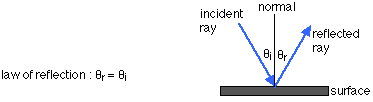
Objects can be seen by the light they emit, or, more often, by the light they reflect. Reflected light obeys the law of reflection, that the angle of reflection equals the angle of incidence.

For objects such as mirrors, with surfaces so smooth that any hills or valleys on the surface are smaller than the wavelength of light, the law of reflection applies on a large scale. All the light travelling in one direction and reflecting from the mirror is reflected in one direction; reflection from such objects is known as specular reflection.
Most objects exhibit diffuse reflection, with light being reflected in all directions. All objects obey the law of reflection on a microscopic level, but if the irregularities on the surface of an object are larger than the wavelength of light, which is usually the case, the light reflects off in all directions.
Source: https://physics.bu.edu/~duffy/PY106/Reflection.html